
Printers have never carried this much weight. Hybrid teams expect badge-free, anywhere access, security insists on zero-trust safeguards, and finance wants proof every device earns its keep. All of it must fit into the cloud workflows you’re already modernising.
That pressure has turned Managed Print Services (MPS) from back-office contract to transformation pillar. According to Quocirca, 89 percent of IT decision-makers now deem MPS essential to digital strategy. In 2026 the payoff isn’t just lower cost—it’s stripped-out risk and friction while letting knowledge workers print less and achieve more.
Over the next few minutes, we’ll unpack the five providers setting the pace—what they excel at, where they stumble, and how to pick the one that fits your environment.
How we picked the winners
Before we name any best-in-class provider, we need clear rules. We examined today’s enterprise print reality: global fleets, cloud-everywhere workflows, and relentless security audits, then built a scorecard that mirrors those pressures.
First, scale. A serious provider has to keep thousands of devices humming across continents without breaking a sweat. Second, security. Print data must be locked down with the same discipline you apply to the rest of your zero-trust network. Third, cloud readiness. According to Quocirca, about three-quarters of organisations now run hybrid print environments, so vendors that cannot span on-prem and cloud environments quickly slip behind.
Analytics and AI follow close behind; predictive maintenance and usage insights turn savings from theory into fact. Service quality matters too: fast fixes, proactive alerts, and SLAs you can enforce. Cost transparency gets its own line on the scorecard because nobody likes a surprise charge in month twelve of a multi-year deal. Finally, sustainability: carbon tracking, energy-smart devices, and genuine recycling programmes show long-term value, not just upfront savings.
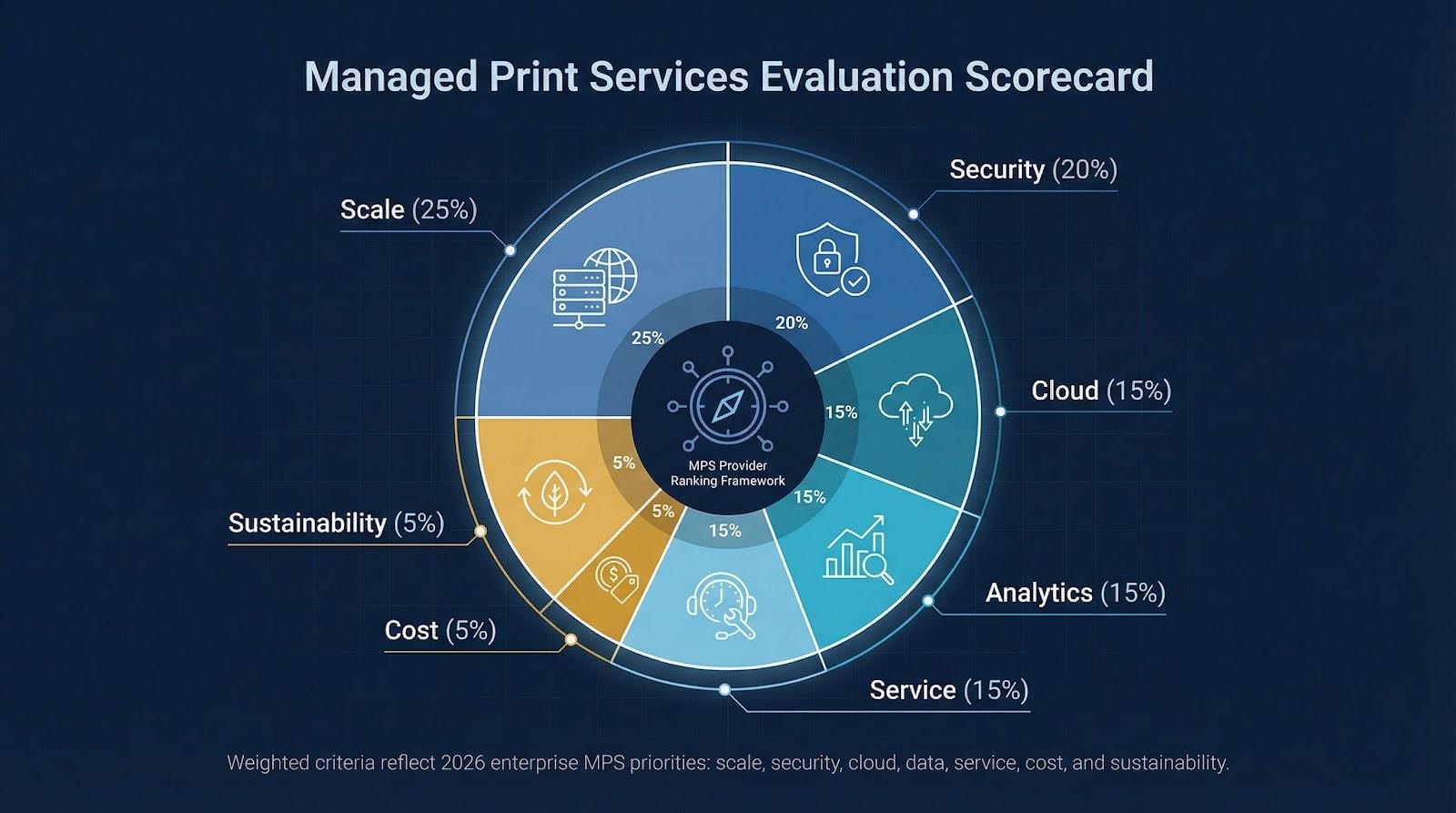
We weighted those seven criteria: scale (25 percent), security (20 percent), cloud (15 percent), analytics (15 percent), service (15 percent), cost (5 percent) and sustainability (5 percent). Each provider then earned a one-to-five score in every category. The numbers created an overall ranking, but they are not the whole story. We tempered the spreadsheet with customer proof, analyst recognition, and real-world case studies so each pick earns its spot when you face the next budget meeting.
This transparent, evidence-first approach sets the stage for the profiles ahead. See how the finalists measure up.
1. TD SYNNEX: multi-vendor mastermind
Imagine walking into a dealership that sells every car brand you like and lets them run on the same fuel card. That is TD SYNNEX in the print world. Formed by the 2021 Tech Data and SYNNEX merger, the distributor sits at the centre of a broad OEM lineup that includes HP, Canon, Xerox, and Lexmark, then bundles everything into one cohesive managed service built on its portfolio of enterprise print solutions that package managed print, document-imaging, and workflow software for organisations ranging from mid-market firms to global enterprises.

TD SYNNEX enterprise print solutions portal screenshot
TD SYNNEX does not manufacture devices; it orchestrates them. You sign one contract that covers hardware, consumables, cloud-print software, and break-fix support even when the fleet is a patchwork of models and ages. For enterprises with legacy gear and new acquisitions, that neutrality is priceless. Procurement negotiates once, yet still keeps competitive pressure behind the scenes as technologies evolve.
Scale feels effortless. TD SYNNEX relies on its global partner network to stage, deploy, and support thousands of printers across regions, matching OEM engineers with local service firms. Need a four-hour onsite SLA in Singapore and a next-day swap in São Paulo? The platform routes the request and you view progress in one dashboard.
Cloud ambitions are covered too. In 2025 the company released packaged integrations for Microsoft Universal Print and other leading cloud-print tools, so resellers can turn legacy queues into secure pull-print workflows without forklift upgrades. Analytics ride alongside: aggregated device telemetry feeds a portal that flags under-used assets, predicts toner depletion, and suggests right-sizing.
A brokered model has trade-offs. Daily support usually flows through a local partner, adding one extra step between you and the technician. Guidance is strong, but prescriptive roadmaps are lighter than what a single-brand OEM might deliver.
Still, when freedom matters more than uniformity, the scorecard tells the story: scalability five, cloud five, pricing transparency five, with solid fours in security, analytics, and sustainability. For complex, mixed fleets, TD SYNNEX turns vendor sprawl into a high-performing ensemble.
2. HP Inc.: security on autopilot, scale on steroids
HP stands alone for one reason: every layer of its print stack, from firmware to cloud console, focuses on blocking threats while keeping teams productive.

Start with the hardware. LaserJet and PageWide devices ship with self-healing BIOS and run-time intrusion detection. If malware tampers with firmware, the printer reboots to a known-good image before anyone notices. Wolf Security fences each job with encryption, certificate checks, and pull-print release. Your auditors see airtight logs; your users see a familiar “tap badge, grab docs” flow.
The software story is just as strong. HP Advance unifies fleet monitoring, secure print, and mobile workflows under one portal. Its new AI engine analyses device telemetry and service tickets, spots patterns, and files proactive fixes. Toner arrives a day before it runs out, and devices schedule maintenance during low-volume windows. Downtime drops, help-desk tickets shrink, and finance finally gets hard numbers on cost per page.
Global coverage is handled too. HP delivers direct service in major markets and certified partners everywhere else, so a five-thousand-device rollout across 30 countries feels routine. The company backs that reach with reliable SLAs (four-hour onsite support for critical sites and next-business-day service for the rest) and publishes compliance data so you can hold it accountable.
Yes, HP charges a premium. But the math evens out when a single breach or day of outage costs more than the contract delta. Subscription models flatten billing, and carbon-neutral printing options satisfy ESG committees, turning the value proposition into measurable impact.
Bottom line: if “never get hacked through a printer” and “never wonder when supplies will show up” top your wish list, HP delivers both at enterprise scale.
3. Xerox: workflow wizardry meets MPS muscle
Xerox invented managed print before the term existed, and that head start shows in its updated focus: less about keeping devices alive, more about removing paper friction from end to end.
Launch a Xerox-managed MFP and the difference is clear. The ConnectKey touchscreen feels more like a phone than a copier panel. One tap sends a patient chart to Epic, a packet to the core banking system, or a contract to DocuSign. These embedded apps eliminate the scan-print-rescan loop that still slows many offices.

Behind the glass, Workflow Central and DocuShare push the advantage further. Documents arrive, get OCR processing, routing, and archiving with metadata intact. Need to redact sensitive data on the fly? There is an app for that as well. This blend of print, capture, and content management keeps Xerox in the Leader quadrant for both MPS and cloud-managed document services.
Service is equally refined. CareAR, the company’s augmented-reality support tool, lets technicians or your IT staff diagnose jams or swap parts through a smartphone lens. Fewer truck rolls mean faster fixes and a smaller carbon footprint, details that surface in your SLA dashboard.
Security meets high expectations: pull print, encryption, and firmware validation. While it trails HP’s advanced stack by a small margin, Xerox still passes every compliance test for healthcare, finance, and government.
Pricing is mostly all-inclusive. You pay one predictable fee and rarely worry about overage charges, though very low-volume sites may find cheaper niche options. For most enterprises, the premium buys measurable gains: universities cutting a million dollars from print budgets, hospitals trimming hours from admission paperwork, retailers reducing device downtime during peak season.
If your transformation agenda revolves around digital workflows, Xerox turns printers into on-ramps and analytics engines rather than cost centres.
4. Lexmark: data-driven, industry-tuned
If your print fleet lives under strict regulations or hides runaway costs, Lexmark (acquired by Xerox in 2025) is the quiet specialist worth a second look. The pitch is simple: let analytics make the calls.
Each Lexmark device sends telemetry to Cloud Fleet Manager, feeding a real-time model that predicts failures, flags under-used machines, and benchmarks cost per user. Union Bank reported a 142 percent return on investment and $5.4 million in savings over three years after optimising its fleet with Lexmark.
Security receives equal focus. Firmware is signed and locked, ports stay dark until you authorise them, and every job can require badge or PIN release. These controls win fans in healthcare and finance, where a stray patient file or statement can trigger fines.
Vertical IQ is the real differentiator. Retail bundles pair receipt printers with shelf-label devices and POS APIs. Healthcare packages drop scans straight into Epic or Cerner while keeping PHI encrypted. That domain focus speeds deployment and cuts “how do we integrate?” calls.
Global reach is solid, though service in smaller regions relies on partners. Hardware breadth is narrower than giants like HP, but for workgroup A4 and A3 needs, durability is proven. Some units rack up a million pages and keep running.
The bottom line: top-tier scores for security, cloud, and analytics with a slight deduction for global coverage. If you want granular data and industry-specific workflows more than big-brand shine, Lexmark delivers.
5. Canon: reliability and image quality rolled into one
Some departments still judge a printer by how the output looks and feels. Marketing wants true-to-brand Pantone reds, legal needs pin-sharp text on every exhibit, and creative teams refuse to accept banding or colour drift. Canon leans into that perfectionism and backs it with a service structure trusted by global banks and design studios alike.
Canon’s imageRUNNER ADVANCE DX line is the workhorse here. Pages emerge crisp, colours stay calibrated week after week, and paper paths shrug off heavy stocks without the usual jam alarm. Pair those devices with uniFLOW Online and you gain the modern essentials: secure pull print, Universal Print integration, and smart rules that nudge users from colour to mono when a draft will do.
Cloud is not an afterthought. The newest firmware ships Universal Print-ready, so remote staff send jobs from home and collect them safely in head office. Admins watch the fleet from a single dashboard that now tracks CO₂ savings by site, a quiet win for sustainability reports.
Support is the second pillar. Canon Solutions America and regional subsidiaries hold direct service contracts that regularly reach 99 percent uptime. When devices falter, IoT diagnostics often trigger a remote fix before users notice. For mission-critical sites, Canon offers two-hour response windows that rivals rarely match without premium surcharges.
The trade-off is brand loyalty. Canon manages its own gear first, and mixed fleets gradually migrate toward its hardware over the contract term. For companies already standardised, or willing to consolidate around best-in-class imaging, that shift is smooth. If you need every brand under the sun, look back at TD SYNNEX.
Add competitive pricing, cartridge recycling that keeps toner out of landfills, and one of the friendliest touch-screen interfaces in the business, and Canon rounds out our top five with a simple promise: prints that look right the first time, every time.
Side-by-side snapshot
Choosing among leaders is easier when you can see the gaps at a glance. The grid below distils each provider’s performance against the seven weighted criteria discussed earlier.

| Provider | Scalability | Security | Cloud & hybrid | Analytics / AI | Service & SLAs | Cost transparency | Sustainability |
| TD SYNNEX | ⭐⭐⭐⭐⭐ | ⭐⭐⭐⭐ | ⭐⭐⭐⭐⭐ | ⭐⭐⭐⭐ | ⭐⭐⭐⭐ | ⭐⭐⭐⭐⭐ | ⭐⭐⭐⭐ |
| HP | ⭐⭐⭐⭐⭐ | ⭐⭐⭐⭐⭐ | ⭐⭐⭐⭐½ | ⭐⭐⭐⭐⭐ | ⭐⭐⭐⭐½ | ⭐⭐⭐⭐ | ⭐⭐⭐⭐⭐ |
| Xerox | ⭐⭐⭐⭐⭐ | ⭐⭐⭐⭐½ | ⭐⭐⭐⭐⭐ | ⭐⭐⭐⭐½ | ⭐⭐⭐⭐⭐ | ⭐⭐⭐⭐ | ⭐⭐⭐⭐½ |
| Lexmark | ⭐⭐⭐⭐½ | ⭐⭐⭐⭐⭐ | ⭐⭐⭐⭐⭐ | ⭐⭐⭐⭐⭐ | ⭐⭐⭐⭐ | ⭐⭐⭐⭐½ | ⭐⭐⭐⭐ |
| Canon | ⭐⭐⭐⭐½ | ⭐⭐⭐⭐½ | ⭐⭐⭐⭐ | ⭐⭐⭐⭐ | ⭐⭐⭐⭐½ | ⭐⭐⭐⭐½ | ⭐⭐⭐⭐⭐ |
A few patterns stand out:
TD SYNNEX leads on cost control and multi-vendor flexibility, ideal when you prioritise choice.
HP dominates security and analytics, making it the safe pick for risk-averse global rollouts.
Xerox posts consistently high marks, with workflow automation giving it an extra edge.
Lexmark shines in data insight; choose it when analytics drive your roadmap.
Canon pairs strong sustainability with market-leading image quality, a blend few rivals match.
FAQs and decision guide
How do I match a provider to our priorities?
Start with the scoreboard. If airtight security tops your board packet, HP or Lexmark rise quickly. Chasing multi-vendor agility and bidding power? TD SYNNEX is built for that. Need workflow automation that removes manual steps? Xerox is the shortest path. And if image quality drives revenue or compliance, Canon’s colour fidelity wins hearts and audits alike.

Will an MPS contract save money?
According to HP, one healthcare system cut printing costs by 48 percent after shifting to HP Managed Print Services. Industry benchmarks land around 20–30 percent savings once you right-size devices and curb waste. Savings stem from fewer devices, less toner panic-buying, and IT hours reclaimed from clearing jams.
Can these vendors manage my existing mixed fleet?
Yes, with caveats. Xerox, HP, and Lexmark all monitor rival devices, though deep analytics often apply only to their own gear. TD SYNNEX stays brand agnostic, which is its purpose. Canon prefers a migration path to Canon hardware, so plan phased replacements if you choose that route.
What security measures should I request?
Look for three basics: firmware validation on every boot, encrypted pull-print release, and central patch control. HP adds self-healing BIOS and run-time intrusion detection. Lexmark hardens devices with secure boot and strict port control. Xerox and Canon meet the same compliance marks with different branding. Always confirm that logs feed your SIEM so print incidents appear with the rest of your alerts.
How flexible are contracts when volumes swing?
All five providers allow device adds or removals mid-term, though notice periods vary. Xerox and HP now sell page-based subscriptions that float with demand. TD SYNNEX can rebalance fleets across vendors if supply-chain hiccups strike. Include volume-band clauses in the SLA to avoid surprise fees.
Should I consolidate on one brand or stay mixed?
Single-brand fleets simplify drivers and parts, which can push uptime past 99 percent. Mixed fleets let you pick niche strengths, such as wide-format from one vendor and secure A4 units from another. If you value simplicity over negotiating leverage, Canon or HP make sense. If flexibility, price tension, or special-use devices matter, keep the mix and turn to TD SYNNEX or a multi-brand OEM willing to manage outsiders.
Use these answers as a quick check before issuing your RFP. A brief audit of costs, risk tolerance, and user pain points will reveal which column in the comparison grid should carry the most weight.
Conclusion
Printers may sit quietly in the corner, but the right managed print partner turns them into secure, data-rich assets that trim costs and advance digital goals. Use the criteria and comparisons above to align each vendor’s strengths with your strategic priorities, and your next print contract will deliver more than pages—it will drive transformation.