
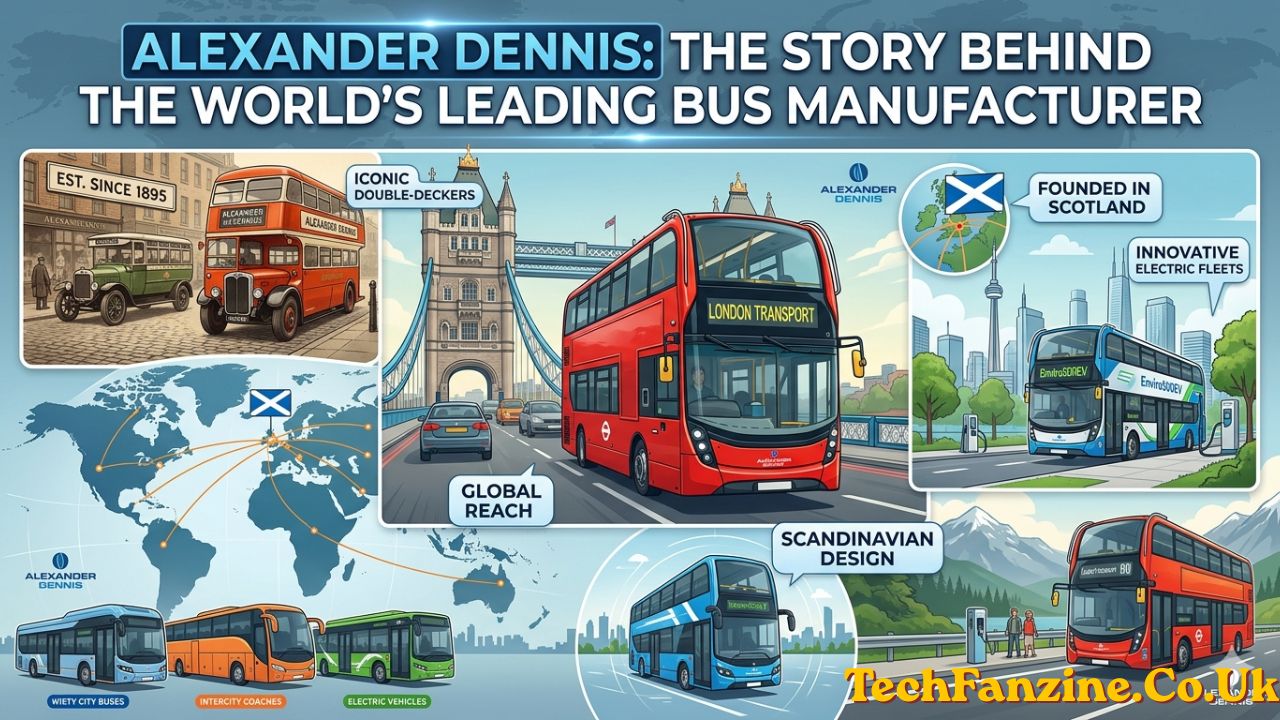
When people think about the buses that move cities, commuters, and entire transit systems across the globe, one name keeps coming up — Alexander Dennis. From the double-deckers rolling through London’s streets to the electric fleets transforming public transport in North America, this Scotland-based company has quietly become one of the most influential forces in global bus manufacturing. Here’s a closer look at who they are, what they build, and where they’re headed.
Who Is Alexander Dennis Limited?
Alexander Dennis Limited, commonly known as ADL, is a bus and coach manufacturing company headquartered in Larbert, Scotland. It holds the distinction of being the largest bus and coach manufacturer in Scotland and, impressively, the world’s largest manufacturer of double-deck and lightweight buses.
Founded in 1895, the company brings over 130 years of engineering heritage and expertise to everything it builds. Today, Alexander Dennis Limited operates as a proud subsidiary of NFI Group Inc., a leading independent bus and coach manufacturer and a global frontrunner in electric mass mobility solutions. For anyone looking to explore their full product range and services, www.alexander-dennis.com remains the go-to destination.
A Legacy Built Over More Than a Century
The roots of Alexander Dennis trace back to three iconic British brands — Walter Alexander, the Dennis Group, and Plaxton — each with a story worth telling.
Dennis started building commercial vehicles in the early 1900s, producing its first buses for local operators and double-deckers for London. By 1908, the company had added fire engines to its portfolio, a product line that would remain central for nearly a century. Meanwhile, Frederick William Plaxton started out as a joinery workshop owner in Scarborough before pivoting into car bodywork and eventually building the company’s first charabanc — the forerunner of the modern coach. Walter Alexander, on the other hand, became a cornerstone of Scottish bus manufacturing.
In 2000, these legacies were merged under the banner of TransBus International, which later became the Alexander Dennis we know today. A major turning point came in May 2019 when the company was acquired by NFI Group in a deal worth £320 million, cementing its place within one of the world’s most powerful transit manufacturing groups.
The Vehicle Range: Built for Every Route
One of the things that makes Alexander Dennis stand out is the sheer breadth of its vehicle lineup. Whether it’s a busy urban corridor or a rural country road, there’s an ADL bus designed for it.
Double-Deck Buses sit at the heart of the range. The Enviro400, Enviro400EV (fully electric), and the Enviro500 — built specifically for the North American market — are among the most recognized vehicles on roads worldwide.
Single-Deck Buses cover a wide spectrum too. The Enviro200 and its electric counterpart the Enviro200EV serve as workhorses for city and interurban routes, while the Enviro100EV brings compact electric mobility to smaller communities. At just 8.5 metres long and 2.35 metres wide, the Enviro100EV is impressively maneuverable for town services, and its 354kWh battery pack delivers a substantial operational range.
In terms of efficiency, the next-generation electric fleet has set new benchmarks. The Enviro100EV has been confirmed at just 0.54 kWh/km in independent testing, while the Enviro400EV clocks in at 0.67 kWh/km — figures that make a compelling financial and environmental case for operators considering the switch to electric.
Coaches round out the portfolio, with the Plaxton Panther leading the way as a flagship long-distance option built to modern standards of comfort and durability.
A Truly Global Manufacturing Presence
Alexander Dennis isn’t just a British company in name — it’s a genuinely global operation. The company has manufacturing plants and active partnerships across Canada, China, Europe, Hong Kong, Malaysia, New Zealand, Singapore, South Africa, and the United States.
One of the most exciting recent developments is the opening of a new manufacturing facility in Las Vegas, Nevada — the only facility in the United States currently producing double-deck buses. Backed by a $15.3 million investment, the facility has already created over 115 local jobs and is producing Enviro500 double-deckers for the RTC of Southern Nevada’s famous Deuce on The Strip route. Production is currently running at one bus per week, with plans to ramp up to 75 vehicles annually.
Back in Scotland, things have been more complex. The Larbert facility is being restructured to serve as a chassis manufacturing site, a move designed to safeguard approximately 350 roles within Scotland. While the Falkirk factory has faced uncertainty, ongoing negotiations with the Scottish Government have helped shape a path forward that retains skilled manufacturing jobs in central Scotland.
Driving the Shift to Zero Emissions
Leading the transition to zero-emission mobility isn’t just a tagline for Alexander Dennis — it’s a core part of how the company operates. As early as 2015, ADL partnered with BYD to produce electric bus bodies, and from 2021, the company began manufacturing its own electric chassis, giving it greater control over its zero-emission product line.
In 2024, the company secured its largest ever single zero-emission bus order — a landmark deal with Stagecoach for 244 next-generation electric buses, including Enviro400EVs, Enviro200EVs, and Enviro100EVs, all funded through the UK Government’s ZEBRA 2 scheme.
ADL has also moved into the retrofitting space through its AD Repower subsidiary, launched in partnership with KleanDrive. The venture specializes in fitting Voith Electrical Drive System drivetrains to existing diesel buses, extending the life of older fleets while dramatically cutting their carbon footprint.
Even autonomous technology is on the agenda. In April 2022, Alexander Dennis commenced trials of an autonomous Enviro200 MMC in collaboration with Stagecoach — a glimpse into what the future of public transit could look like.
Where ADL Stands in the Market
Despite a challenging competitive landscape, Alexander Dennis continues to lead the UK bus market. By October 2024, the company had delivered around 1,080 buses, with full-year projections pointing toward 1,500 — comfortably ahead of its nearest competitor.
That said, the competitive pressure is real. Chinese electric bus manufacturers have dramatically increased their share of the UK market, rising from around 10% to 35% in recent years. In 2025, 51% of all zero-emission buses purchased in the UK came from overseas — a sharp 25 percentage point increase from the prior year. For those following the latest alexander dennis news, this tension between domestic manufacturers and international competitors has been one of the defining stories of the sector.
Key Partnerships and Major Contracts
No company operates in isolation, and Alexander Dennis Limited has built a strong network of partnerships that help it deliver at scale.
NFI Group, as the parent company, provides global manufacturing and electrification support. The BYD partnership brought early electric bus production to the UK market. Stagecoach has been a major fleet customer for both zero-emission and conventional vehicles. Arriva UK Bus placed an order for 164 Enviro200 and Enviro400 low-emission buses to support fleet modernisation across England and Wales. And in the United States, RTC of Southern Nevada is taking delivery of Enviro500 double-deckers directly from the new Las Vegas facility.
After-Sales Support: AD24
Selling buses is only part of the picture. Alexander Dennis Limited takes after-sales seriously through its AD24 service platform — a comprehensive support offering that promises any part, any service, any make, any time. This aftermarket business has proven to be a significant and stable revenue stream, especially as the company navigates the transition from diesel to electric vehicles.
Fleet lifecycle management, parts supply, and technical support are all part of what AD24 delivers, helping operators keep their buses on the road and performing at their best.
Challenges, Restructuring, and the Road Ahead
The past couple of years have tested Alexander Dennis in meaningful ways. In 2025, the company announced a consultation to consolidate UK bus body manufacturing into a single site in Scarborough, with the proposed closure of its Falkirk factory putting up to 400 roles at risk. This restructuring was driven by the need to reduce costs and eliminate duplication in the face of stiff competition.
The Scottish Government responded by working with the company on a furlough scheme to protect jobs — a first-of-its-kind arrangement that allowed Alexander Dennis to propose a revised outcome, retaining chassis manufacturing at Larbert and keeping hundreds of skilled workers employed.
The broader policy environment has also been a point of tension, with critics noting that government funding schemes have increasingly directed orders to overseas manufacturers rather than prioritising domestic production.
What’s Next: Careers, Community, and Clean Transport
For those interested in alexander dennis jobs, the company is actively recruiting across engineering, manufacturing, and support functions as it scales its zero-emission product lines. Career opportunities in electric and autonomous bus technology are growing, and the company emphasizes workforce development as part of its long-term mission.
At its Las Vegas facility, Buy America compliance means over 70% of materials and components are sourced from US-based suppliers — a strong signal of the company’s commitment to local economies wherever it operates.
The alexander dennis logo — refreshed in June 2022 alongside the opening of its Trident House complex in Farnborough — reflects the company’s evolving identity: modern, forward-looking, and rooted in a proud industrial heritage.
The long-term vision is clear: to expand electric and autonomous bus capabilities globally, lead the industry’s green transition, and continue building on 130 years of manufacturing excellence. For the latest updates, visit www.alexander-dennis.com.
Also Read: Mark McCann: The YouTube Star Who Turned His Passion for Cars Into a Digital Empire