
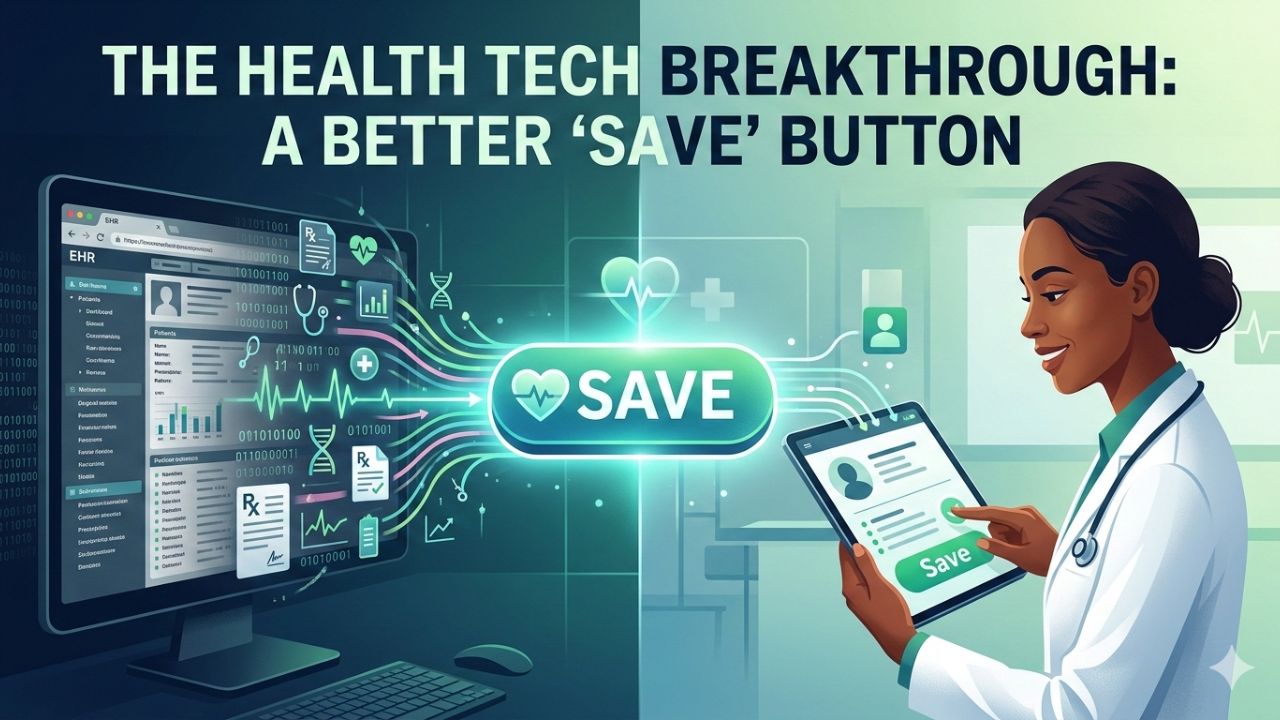
In the broader world of software development, we’ve spent the last decade obsessing over the “user journey.” Whether it’s a fintech app or a project management tool, the goal is always the same: reduce friction, eliminate unnecessary clicks, and guide the user toward a “flow state.”
But in the world of Health Tech, we’ve historically ignored these principles in favor of raw data accumulation and billing compliance.
But can you really optimize a clinical relationship with an algorithm? Honestly, I’ve seen enough “efficient” dashboards to know that more data often means more noise.
The result is a landscape where doctors are drowning in information but starving for actual insight. For primary care physicians, the “generalists” who have to synthesize data from dozens of different specialists, this isn’t just a nuisance. It’s a systemic failure that leads to professional burnout and, in the worst cases, clinical errors. It’s hard to feel like a healer when you feel like a data entry clerk.
And that is a problem for all of us.
As we look toward the next generation of medical infrastructure, the conversation is finally shifting. We’re moving away from the era of “Big Data” and into the era of “Useful Data.”
The Data Paradox in Modern Medicine
We often hear that interoperability, the ability for different systems to talk to each other, is the “holy grail” of healthcare. On paper, it sounds perfect. A primary care doctor should be able to see every lab result, every imaging report, and every specialist note in real time.
But there’s a catch. When you open the firehose of data without a filter, you create a massive cognitive burden. A clinician during a 15-minute visit can’t possibly sift through a 300-page PDF of unstructured data to find one relevant trend in a patient’s kidney function. You can almost feel the phantom weight of those digital pages clicking by as the clock ticks down.
This is where the interface design becomes a clinical tool in its own right. If the software doesn’t prioritize the most “high-signal” information, it’s failing the user. This is particularly true in the generalist space, Medical billing software plays a crucial role in modern healthcare systems, especially in environments where incoming data volume is at its highest. Designers are now realizing that a specialized EHR software for primary care needs to function differently than a system designed for a surgeon or a radiologist.
It needs to be a storytelling engine, not just a database.
Designing for the “Flow State” in a Crisis
In tech, we talk a lot about the “Flow State,” that moment when the tool becomes an extension of the mind. In an exam room, that flow is the connection between the doctor and the patient.
Every time a doctor has to turn their back to the patient to navigate a sub-menu or hunt for a “save” button, that connection is broken. You know that awkward silence when the doctor is busy spinning a loading icon instead of listening to a patient’s concerns.
To fix this, developers are moving toward “minimalist” interfaces. This doesn’t mean stripped-down features: it means more intelligent ones. It’s about using predictive logic to surface the information the doctor likely needs based on why the patient is there. If a patient is coming in for a diabetes follow-up, the system should automatically highlight the most recent A1C levels and foot exam results.
By reducing the “number of clicks to completion,” we aren’t just making doctors faster.
We’re making them more present.
The Problem with One-Size-Fits-All Platforms
For years, the market was dominated by “monolithic” software platforms. These systems tried to be everything to everyone: a billing system, a surgical scheduler, a pediatric growth chart, and a pharmacy portal all rolled into one.
In the tech world, we know exactly what happens to monolithic architectures. They become brittle. They become slow. And they become nearly impossible to update without breaking something else. In healthcare, they become a massive source of resentment. I’ve heard clinicians describe their EHRs as “the most expensive typewriter they ever bought.”
The future belongs to specialized, “best of breed” solutions. A primary care physician has a fundamentally different mental model of a patient than an oncologist does. One sees a decades-long relationship: the other sees a specific, acute battle. The software has to reflect that mental model. When we build tools that are “purpose-built” for the specific workflow of a primary care environment, we respect the user’s expertise.
We stop asking the doctor to adapt to the computer and start asking the computer to adapt to the doctor.
Security, Trust, and the “Invisible” Backend
Of course, a beautiful UI is worthless if the backend isn’t secure. In the tech sector, we’ve seen a massive shift toward “Zero Trust” architectures and advanced encryption. In Health Tech, this is absolutely non-negotiable.
However, the “tech” challenge here is making that security invisible. A doctor shouldn’t have to jump through three separate two-factor authentication steps to view a patient’s blood pressure history. The next frontier of medical tech is using biometric and contextual authentication to keep data safe without slowing care.
When we talk about the “stack” behind a modern medical office, we’re talking about a sophisticated blend of cloud computing, real-time data streaming, and ironclad security protocols. It’s a technical feat that, if done correctly, the user never even notices.
It just works.
The Path Forward: Simplicity as a Feature
As we look at the trends across the tech sector, the direction is clear: we’re entering the era of “Human-Centric Engineering.” Whether it’s in consumer electronics or clinical software, the goal is for the technology to disappear.
The most “compelling” tech in the world isn’t the one with the most bells and whistles. It’s the one that lets the human at the center of the process do their best work with the least amount of friction. In the healthcare space, that means building systems that understand the rhythm of a primary care practice. It means valuing the “User Experience” as much as we value the “Clinical Outcome.”
Because in the end, you really can’t have one without the other.
Ultimately, we’re moving toward a future where the “computer” is no longer a third party in the exam room. It’s a silent partner, handling the data so humans can focus on the healing. It’s a long road to get there, but for the first time in a while, the tech is moving in the right direction. Or at least, it’s finally starting to feel like it was built for us.
Also Read: The Creator Ethics Guide: Disclosures, Claims, and Trust