
Introduction: The Reality of Hybrid Environments
Despite the momentum toward cloud computing, most enterprises operate hybrid environments that span on-premises data centers and public cloud platforms. Legacy systems, regulatory requirements, latency constraints, and investment protection all contribute to the persistence of on-premises infrastructure alongside growing cloud adoption.
Hybrid cloud architecture enables organizations to leverage the best of both worlds—the control and performance of on-premises infrastructure combined with the scalability and innovation of public cloud. Done well, hybrid architectures provide flexibility, optimize costs, and enable gradual cloud migration without disruptive big-bang transformations.
This comprehensive guide explores strategies for building effective hybrid cloud architectures. From connectivity and security to workload placement and operations, we examine how organizations can create integrated environments that deliver business value while managing complexity.
Understanding Hybrid Cloud Models
Hybrid cloud encompasses various integration patterns depending on how organizations connect and coordinate on-premises and cloud resources.
| Model | Description | Use Cases |
| Cloud Bursting | Overflow to cloud during demand spikes | Variable workloads, seasonal peaks |
| Tiered | Different tiers for different workload types | Dev/test in cloud, production on-prem |
| Distributed | Workloads run where most appropriate | Multi-location operations |
| Unified | Single operating model across environments | Mature hybrid operations |
| Edge-Integrated | Edge, on-prem, and cloud together | IoT, latency-sensitive applications |
Connectivity Strategies
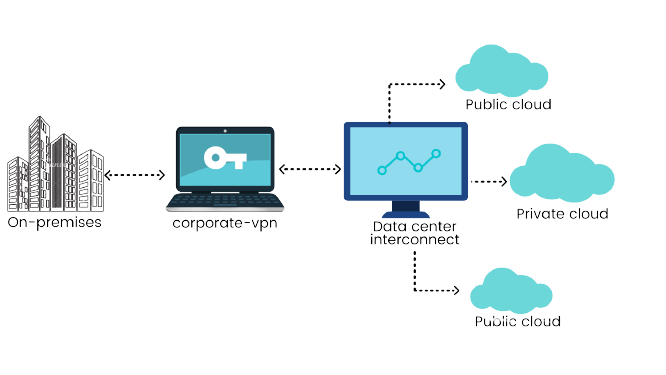
Reliable, secure connectivity between on-premises and cloud environments forms the foundation of hybrid architecture. Organizations must balance bandwidth, latency, cost, and redundancy requirements.
Connection Options
| Option | Characteristics | Best For |
| VPN over Internet | Encrypted tunnel, variable performance | Light traffic, cost-sensitive |
| Dedicated Connection | Private circuit, consistent performance | High bandwidth, low latency needs |
| Cloud Interconnect | Direct connection via cloud exchange | Multi-cloud, ecosystem access |
| SD-WAN | Software-defined, application-aware | Distributed organizations, flexibility |
Organizations designing hybrid connectivity benefit from working with experienced cloud infrastructure specialists who understand the nuances of different connection options and can design solutions that balance performance, reliability, and cost requirements.
Identity and Access Management
Consistent identity management across hybrid environments ensures users and applications can authenticate seamlessly while maintaining security controls.
Hybrid Identity Patterns
- Directory synchronization between on-premises AD and cloud identity
- Federation enabling SSO across environments
- Privileged access management spanning all infrastructure
- Consistent RBAC policies across on-premises and cloud
- Centralized audit logging for compliance visibility
Security Across Hybrid Environments
Hybrid security must address the expanded attack surface created by connecting disparate environments while maintaining consistent protection regardless of where workloads run.
Security Considerations
| Domain | Challenge | Approach |
| Network | Securing traffic between environments | Encryption, segmentation, firewalls |
| Data | Protecting data across locations | Encryption, classification, DLP |
| Identity | Consistent access control | Federation, centralized IAM |
| Compliance | Meeting requirements everywhere | Unified policies, audit capabilities |
| Visibility | Seeing across all environments | Centralized SIEM, unified monitoring |
Implementing continuous vulnerability scanning across hybrid infrastructure ensures that security weaknesses are identified regardless of whether they exist in on-premises systems or cloud resources, providing unified visibility into security posture.
Workload Placement Decisions
Determining where workloads should run is a critical hybrid architecture decision. Multiple factors influence optimal placement.
Placement Criteria
- Latency requirements—applications needing low latency may require on-premises or edge
- Data gravity—workloads should be near the data they process
- Compliance—regulatory requirements may mandate specific locations
- Cost—economics of cloud versus on-premises for specific workload profiles
- Integration—dependencies on other systems and their locations
Data Management Strategies
Data management in hybrid environments must address replication, synchronization, and consistency across distributed storage systems.
| Strategy | Description | Considerations |
| Primary On-Prem | Data masters on-premises, cloud copies | Latency for cloud access, sync complexity |
| Primary Cloud | Data masters in cloud, on-prem cache | Internet dependency, egress costs |
| Distributed | Data distributed based on access patterns | Consistency management, complexity |
| Tiered | Hot data on-prem, cold/archive in cloud | Access patterns, migration automation |
Unified Operations and Management
Operating hybrid environments effectively requires tools and processes that provide consistent management regardless of where resources reside.
Operational Capabilities
- Unified monitoring across on-premises and cloud resources
- Consistent automation and orchestration
- Centralized logging and observability
- Integrated incident management processes
- Consolidated cost management and optimization
Disaster Recovery in Hybrid Environments
Hybrid architectures can strengthen disaster recovery by leveraging cloud resources for backup and failover while maintaining on-premises primary operations.
- Cloud-based backup for on-premises workloads
- Failover to cloud during on-premises outages
- Geographic distribution for regional disaster protection
- Pilot light or warm standby architectures in cloud
Cost Management
Hybrid environments require sophisticated cost management that accounts for both on-premises infrastructure and cloud consumption.
| Cost Category | On-Premises | Cloud |
| Compute | Server purchase, depreciation | Pay-per-use, reserved instances |
| Storage | SAN/NAS, media costs | Tiered storage pricing |
| Network | WAN circuits, equipment | Egress charges, connection fees |
| Operations | Staff, facilities, power | Reduced but still present |
| Hidden Costs | Opportunity cost, inflexibility | Skills, integration complexity |
Migration and Modernization
Many organizations use hybrid architecture as a stepping stone in gradual cloud migration, modernizing applications over time while maintaining business continuity.
- Assess workloads for cloud readiness and migration approach
- Prioritize migrations based on business value and complexity
- Execute migrations in waves with validation checkpoints
- Modernize applications to leverage cloud-native capabilities
- Decommission on-premises resources as workloads migrate
Conclusion: Embracing Hybrid Reality
Hybrid cloud is not a transitional state but a strategic architecture that many organizations will maintain indefinitely. The key to success lies in treating hybrid as a deliberate design choice rather than an accident of circumstance.
Effective hybrid architecture requires investment in connectivity, consistent security, unified operations, and clear governance. Organizations that master these elements can leverage the unique strengths of both on-premises and cloud infrastructure while minimizing the complexity that hybrid environments can introduce.
The future belongs to organizations that can fluidly deploy workloads wherever they run best, adapting placement as requirements evolve. Building hybrid capabilities today positions organizations for this flexible future while delivering immediate value through optimized infrastructure utilization.