
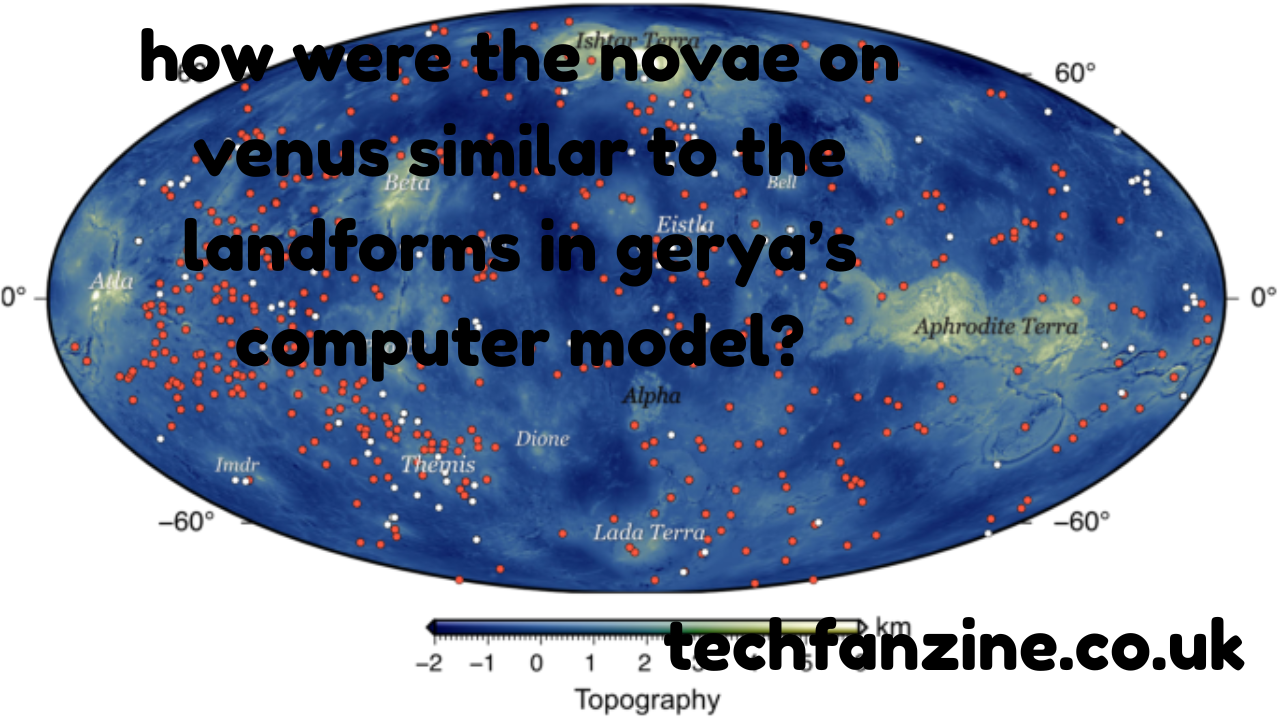
The question how were the novae on Venus similar to the landforms in Gerya’s computer model? touches on a fascinating interplay between planetary observation and theoretical modelling. In this article, we unpack what novae on Venus really are, what the Taras Gerya computer‑model depicts, and why scientists consider the similarity meaningful.
What are “novae” on Venus

On Venus, “novae” refer to peculiar surface landforms characterized by radial or star‑shaped fracture patterns, concentric ridges or grabens (trench-like faults), and central domes or uplifts. Wikipedia+2LPI+2
Specifically:
- A nova typically spans between roughly 50 to 300 kilometers in diameter, although there is variation across different novae. DDS Data Distribution and Deposit System+1
- Morphologically, many novae exhibit radial fractures — fractures radiating outward from a central point — sometimes combined with concentric rings of ridges or faults surrounding the central uplift. LPI+2Studocu+2
- These features are believed to be volcanic or tectonic in origin: the radial fractures reflect a pattern of magma-driven intrusion from below, causing the crust to fracture outward from a central upwelling point. Wikipedia+2Jupiter+2
Thus, novae represent evidence that Venus’s lithosphere (crust + upper mantle) has undergone internal stress, magma intrusion, uplift and deformation — not simply passive lava flows but more dynamic internal processes.
What is Gerya’s Computer Model

Taras Gerya and collaborators developed a 3D thermomechanical simulation model of a planet’s lithosphere and mantle — adapted to Venus’s conditions (thin lithosphere, high temperatures, mantle plumes) — to explore how internal processes might shape surface landforms. Jupiter+2ETH Zürich+2
Key aspects of the model:
- The model assumes a relatively thin, warm lithosphere rather than a thick, rigid one. This is important because a thin lithosphere is more susceptible to deformation under mantle dynamics. ETH Zürich+1
- It simulates mantle plumes: columns or blobs of hot, partially molten rock rising from deep in the mantle. When such a plume impinges on the lithosphere from below, it can induce melting, create magma chambers, and cause the overlying crust to bulge upward. ETH Zürich+1
- As magma accumulates beneath the crust, internal convection within that magma-rich region can lead to uplift, dome formation, and eventually fracturing — forming radial and concentric fault/ridge patterns on the surface. Technology+2Jupiter+2
- Over geologic time, these dome‑and‑fracture structures may further evolve — with concentric faults, graben, ridges — sometimes transitioning into larger, more complex structures (on Venus, these are called coronae). ETH Zürich+2Jupiter+2
In short: Gerya’s model provides a physically grounded way to simulate how internal mantle dynamics — especially plume activity — can deform a planet’s lithosphere and produce surface landforms.
Direct Similarities Between Novae on Venus and Gerya’s Model
Comparing the real novae on Venus with the simulated landforms in Gerya’s model reveals several striking parallels. These similarities lend support to the hypothesis that novae on Venus result from mantle-plume-driven uplift and deformation, rather than being random or unrelated features. The main parallels:
Magma Upwelling & Uplift
- Both the observed novae and the simulated landforms in Gerya’s model stem from magma upwelling from the interior. In the model, a mantle plume rises, melts materials, accumulates magma beneath the crust, then pushes upward to bulge the surface. ETH Zürich+2Jupiter+2
- On Venus, novae are interpreted to arise because of similar upwelling — magma intruding, deforming the crust, causing uplift and central dome formation. Wikipedia+2LPI+2
Thus, the driving mechanism — internal mantle dynamics, magma intrusion — is common to both.
Dome or Central Uplift + Radial Fracture Patterns
- Gerya’s simulations produce a central dome or uplift over a magma-rich region, with radial fractures emanating outward from the center. Technology+2Jupiter+2
- Observed novae on Venus often display exactly that morphology: central uplift or bulge, surrounded by radial networks of dikes or grabens (fractures). Wikipedia+2LPI+2
This structural similarity — dome + radial fractures — is one of the strongest supports that the model reflects real processes.
Concentric Faults / Ridges / Graben Around the Dome
- Beyond radial fractures, Gerya’s model also shows concentric faulting/ridges/graben forming as the crust flexes and deforms around the uplifted region. Technology+2Jupiter+2
- Many novae exhibit concentric rings of ridges or grabens (trench‑like faults or ridges) around their central uplift — often nested, forming annular structures. LPI+2DDS Data Distribution and Deposit System+2
Thus the concentric structural architecture of many novae aligns with what the model predicts under plume‑driven uplift and crustal deformation.
Compatibility with Venusian Conditions (Thin Lithosphere, High Heat)
- Gerya’s model was tailored for a warm, thin lithosphere — conditions that are plausible for Venus given its high surface and mantle temperatures, and lack of Earth-like plate tectonics. ETH Zürich+2Technology+2
- The fact that the model still reproduces realistic-looking novae suggests that Venus’s lithosphere behaves more like the model assumes (thin, ductile enough to deform), rather than rigid, thick crust — which supports the geological plausibility of plume-driven formation of novae. Jupiter+2DDS Data Distribution and Deposit System+2
Evolution — Novae → Coronae
- According to Gerya’s simulations, a nova-like structure generated by a mantle plume can — over millions of years — evolve into a more complex structure known as a corona, if molten rock continues to rise and magma interacts with the lithosphere in a prolonged manner. ETH Zürich+2Technology+2
- On Venus, there are many coronae (hundreds), which share morphological traits with novae (raised rim, concentric rings, fractures, volcanic and tectonic features). Jupiter+2Wikipedia+2
This evolutionary link proposed by the model offers a coherent framework: novae may represent an earlier stage of corona formation, bridging simple magma‐uplift domes to more complex coronae structures.
Why the Match Matters — Scientific Implications
The similarity between observed novae and Gerya’s modeled landforms is not just a curiosity — it provides important clues about Venus’s geological history and interior dynamics.
First, it supports the hypothesis that Venus remains geologically active, or at least was recently active: the mantle plume mechanism implies internal heat and convection. If novae reflect plume‑driven deformation, Venus’s interior may be more dynamic than a static “dead rock.”
Second, it implies that Venus’s lithosphere could be thin and ductile (or was in the past), rather than thick and rigid. This has major implications for how we understand Venus’s heat transport, volcanic activity, and tectonic evolution.
Third, by offering a plausible formation mechanism for novae — and by extension coronae — the model helps explain the diverse range of surface landforms on Venus under a unified theory of mantle dynamics + lithospheric deformation, rather than requiring separate, unrelated processes for each feature type.
Finally, the match enhances our confidence in using computer simulations and physics-based modelling to interpret planetary geology — especially on planets like Venus, where direct sampling is currently impossible.
Limitations, Caveats, and What We Don’t Know
While the similarities are compelling, it’s important to note some limitations and uncertainties:
- Gerya himself acknowledged that his model cannot reproduce all landforms observed on Venus. Some novae or coronae on Venus are larger, more complex, or have additional features that the model does not fully simulate. ETH Zürich+1
- The size of the simulated novae in the model tend to be smaller (e.g., “three times smaller than the original,” in some cases) than the largest novae observed on Venus. ETH Zürich+1
- Venus’s lithosphere, crustal composition, thermal history, and interior dynamics may have varied over geological time; the assumptions in the model (thin lithosphere, particular plume size, viscosity, temperature profile) are plausible but not definitively proven.
- Alternative formation mechanisms might still play a role: while plume-induced uplift is attractive and matches many observations, other processes (e.g., crustal flexure, regional tectonics, large‑scale volcanic flooding) could also contribute to or modify these landforms.
Thus, while the match is powerful evidence, it is not a definitive proof that all novae (or coronae) on Venus formed exactly as in the model.
Conclusion — What the Similarity Reveals
The similarity between the novae on Venus and the landforms generated in Gerya’s computer model offers a compelling argument that many of Venus’s surface features arise from internal mantle dynamics — specifically, magma upwelling, lithospheric uplift, and crustal deformation.
Through Gerya’s 3D thermomechanical simulations, scientists gained a tangible, physics-grounded framework to reproduce key morphological characteristics: central domes, radial fractures, concentric fault/ridge rings — all hallmarks of Venusian novae. The congruence strongly suggests that novae on Venus are not random surface oddities, but rather the visible fingerprints of a once-active (or perhaps still active) mantle and lithosphere.
While uncertainties remain — especially regarding scale discrepancies, Venus’s precise thermal and rheological history, and possible alternative mechanisms — the match significantly advances our understanding of Venusian geology. It demonstrates that computer modeling, when carefully parameterized for conditions like those on Venus, can offer real insight into planetary processes far beyond Earth.
In summary: novae on Venus resemble the landforms in Gerya’s computer model because both reflect the same underlying processes — magma upwelling from the mantle, crustal uplift, and deformation under a thin, warm lithosphere — producing domes with radial and concentric fractures, ridges, and faults. This correspondence strengthens the hypothesis that mantle‑plume activity has shaped much of Venus’s geologic surface, and positions Gerya’s model as a valuable tool for interpreting Venus’s mysterious landscape.