
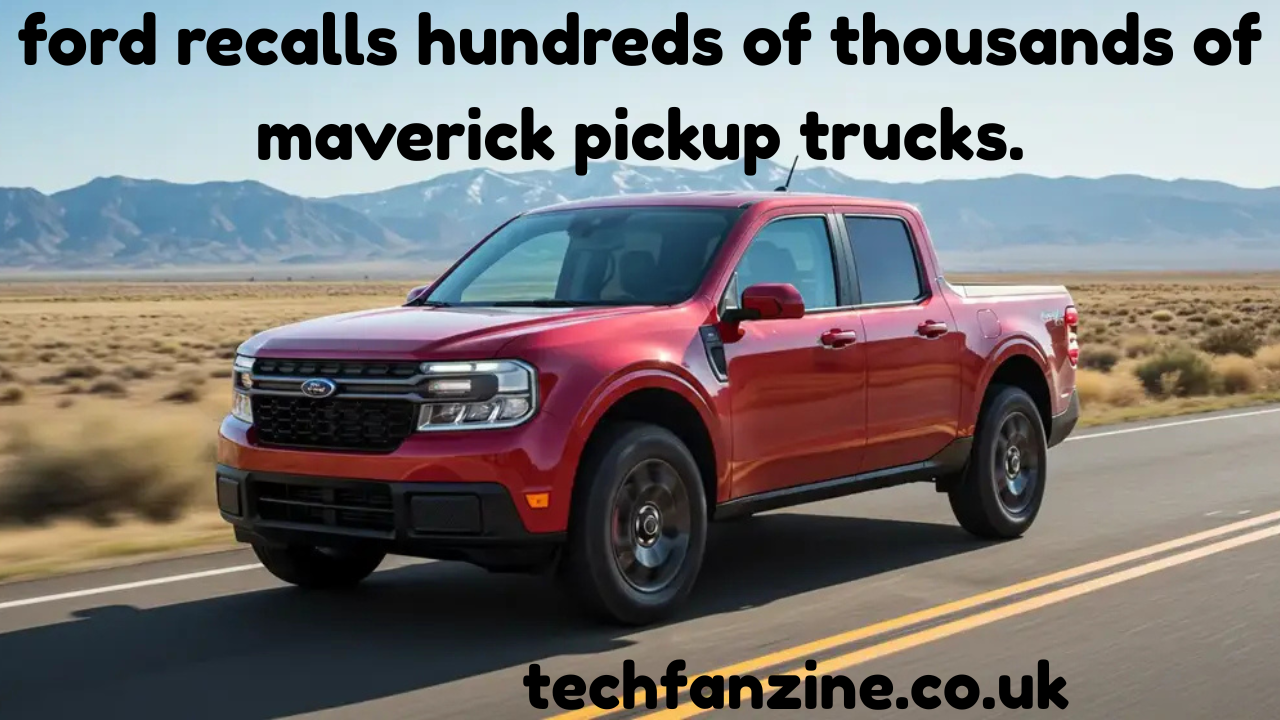
In a major automotive safety effort, Ford recalls hundreds of thousands of Maverick pickup trucks—a sweeping action that underscores the challenges facing one of America’s most talked‑about compact pickup models. These recalls address multiple safety issues ranging from airbag indicator light concerns to parking‑gear malfunctions and rear lighting defects. In this detailed investigation, we unpack why these recalls were issued, which Mavericks are affected, the risks involved, how Ford is responding, and what owners need to know going forward.
What Does “Ford Recalls Hundreds of Thousands of Maverick Pickup Trucks” Mean?

When we say Ford recalls hundreds of thousands of Maverick pickup trucks, it refers to Ford Motor Company officially notifying owners and regulators that specific Maverick models have defects or non‑compliance with safety standards that could pose a risk if not fixed. These recalls are voluntary actions by Ford but mandated and overseen by the U.S. National Highway Traffic Safety Administration (NHTSA), which ensures that vehicles on the road meet strict safety standards.
Ford has issued multiple recalls through 2024 and into 2025 involving a combined total of well over 200,000 Mavericks, spread across different problem categories and model years. Automotive Fleet+1
Key Recalls Affecting Maverick Pickup Trucks

1. Airbag Indicator Light Defect
One of the most significant recent actions saw Ford recall more than 63,000 Maverick pickup trucks from the 2025 model year because their airbag indicator light could become dislodged or invisible to drivers. This is not a cosmetic issue—if the indicator cannot be seen, drivers might not know whether the passenger airbag is active, which is a critical safety feature. Dealers will install retaining clips to secure the light as a free repair. Kbb.com
2. Rear Lighting and Body Control Module Issues
Earlier in the Maverick’s production run, more than 242,000 trucks from the 2022‑2024 model years were recalled due to a Body Control Module (BCM) defect that could cause taillights to fail to illuminate properly. The BCM could falsely detect a circuit overload, turning off rear position lamps unexpectedly. This increases crash risk, especially at night or in low‑visibility conditions. Automotive Fleet
3. Integrated Parking Module Rollaway Risk
In late 2025, Ford expanded a broad recall that included many Maverick hybrid trucks built between 2025 and 2026 due to a software defect in the integrated parking module. This issue could cause the transmission not to fully engage Park, increasing the risk of the vehicle rolling away if the parking brake isn’t used properly. This recall affected parts of a larger 272,000+ vehicle campaign that also included F‑150 Lightning and Mustang Mach‑E models. A software fix will be offered free of charge. Ford-Trucks.com+1
4. Other Technical Recalls (Historical Context)
While not part of the more recent mass recalls, earlier actions on Maverick trucks have included fix campaigns for backup camera freezing, turn signal warning absence, and instances where previously completed recall work was later corrected because the wrong software was installed. These earlier recalls reflect the ongoing refinement in responding to complex electrical and software systems in modern compact pickups. The Car Connection+2autoevolution+2
Why So Many Recalls on the Maverick? Understanding the Root Causes
Modern Vehicle Complexity
The Maverick is a compact pickup built with modern safety and electronic systems. As with many contemporary vehicles, a large portion of recalls involve software‑driven components—from parking logic to body control modules—that are more complex than traditional mechanical systems. When those systems behave unpredictably, safety regulators escalate recalls to ensure compliance with federal standards.
Rapid Feedback and Reporting
Today’s vehicles often send diagnostic data back to manufacturers long before owners notice symptoms. This telemetry enables issues to be identified and acted upon more quickly than in past decades, which can mean multiple recalls early in a vehicle’s lifecycle.
Multiple Model Years and Production Batches
The Maverick has been produced in large numbers over several model years with hardware and software changes between production dates. When a defect is identified in a manufacturing batch, the recall often spans model years that share the same part or software version.
Safety Implications for Owners and the Public
Crash and Injury Risks
Each recall addresses a distinct safety risk:
- Airbag indicator visibility problems can obscure critical safety information to occupants, potentially leading to incorrect assumptions about airbag status. Kbb.com
- Rear lighting failures reduce visibility to other drivers at night or in poor conditions, raising the risk of rear‑end collisions. Automotive Fleet
- Parking disengagement defects could allow a vehicle to roll away if Park isn’t properly engaged, posing danger to pedestrians, property, and nearby vehicles. EV.com
Ford and the NHTSA generally indicate that they are not aware of widespread crashes tied directly to the latest recalls—but that does not diminish the precautionary need to address these risks through official repairs.
What Ford Owners Should Do Now
Check Your Vehicle’s Recall Status
Owners of Maverick pickup trucks should immediately check whether their specific VIN is part of any recall campaign. This can be done through official NHTSA recall lookup tools or by contacting a Ford dealer directly with their VIN. Dealerships will perform recall repairs free of charge.
Schedule Repairs Promptly
Even if a recalled issue seems minor, it’s important to schedule the fix. Undiagnosed safety issues can become significant hazards if left unaddressed—particularly with lighting or airbag systems.
Keep Records of Repairs
Make sure to retain documentation for all recall work completed. If there are follow‑on recalls or if a future recall overlaps with prior work, having detailed service records helps ensure you receive proper fixes with no duplication or gaps.
Looking Ahead: The Broader Context of Maverick Recalls
The fact that Ford recalls hundreds of thousands of Maverick pickup trucks reflects broader trends in the automotive industry: increased software complexity, higher regulatory oversight, and proactive safety transparency. Recalls are not unique to Ford or the Maverick; most manufacturers issue periodic recalls as part of responsible product stewardship. What matters most is how quickly and effectively these issues are resolved to keep drivers and the public safe.