
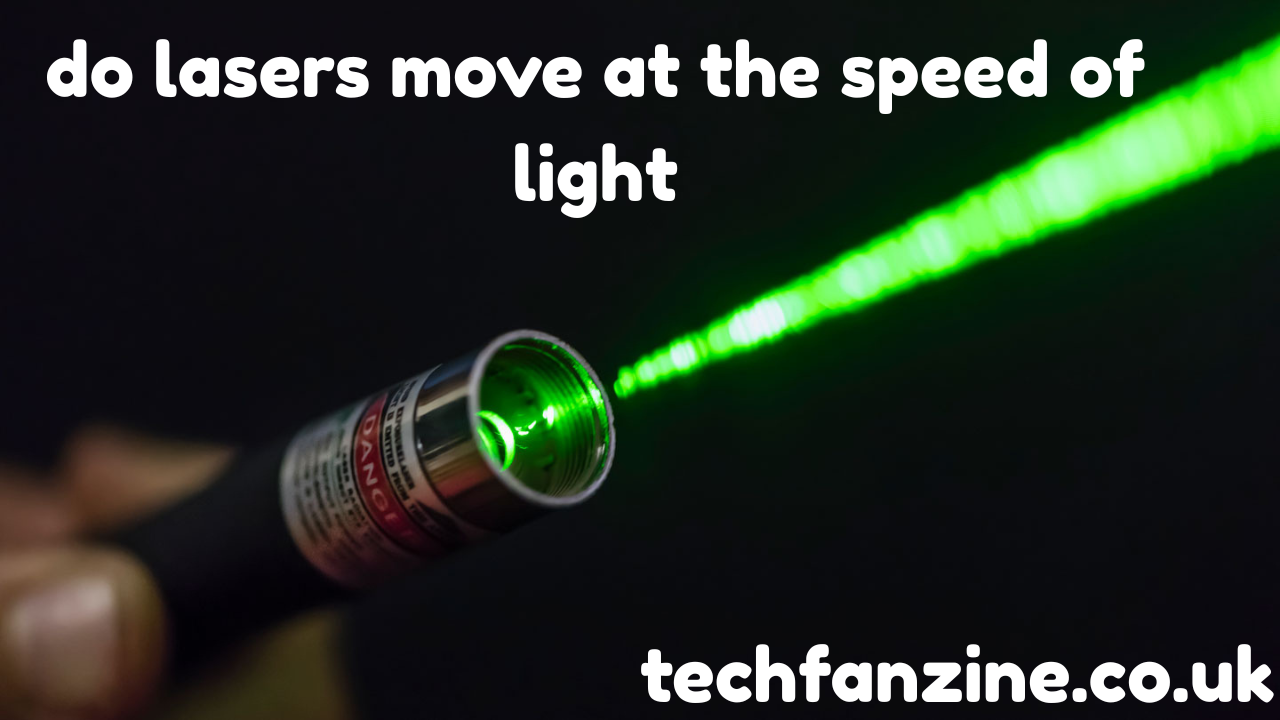
Understanding how lasers travel is one of the most fascinating discussions in modern physics. When people ask “do lasers move at the speed of light?”, they often imagine a laser beam shooting instantly from one point to another like in sci-fi movies. But the real scientific explanation is deeper, richer, and more surprising.
This article explores in detail how laser light behaves, whether are lasers faster than light in any possible scenario, and why the speed of light forms a universal limit in physics. You will find clear explanations, scientific principles, examples, and misconceptions broken down with easy-to-understand logic.
What Exactly Is a Laser and How Does It Produce Light?

To understand do lasers move at the speed of light, we should first know what a laser is.
The word LASER stands for:
Light Amplification by Stimulated Emission of Radiation
A laser is a device that produces a narrow, highly focused beam of light with the following properties:
- Monochromatic (one color or wavelength)
- Coherent (waves are perfectly aligned)
- Collimated (travels in a straight, tight beam)
Even though laser light has unique characteristics, it is still light, and therefore it falls under the same physical laws that govern all electromagnetic radiation.
This means that if nothing interferes with it, a laser beam in a vacuum should travel at the same fundamental speed that all light does.
Do Lasers Move at the Speed of Light? The Short Scientific Answer

Yes — in a vacuum, lasers move at the speed of light.
Light in a vacuum always travels at the same universal speed known as c, which is:
299,792,458 meters per second (approximately 300,000 km/s)
Laser beams are not special particles; they are simply highly organized light. So a laser beam in space, where nothing slows it down, will travel exactly at the speed of light.
However, the more detailed explanation becomes interesting when we consider how light behaves in air, glass, water, or other materials.
If Lasers Move at the Speed of Light, Why Do They Sometimes Slow Down?
Many people get confused because textbooks say something like:
“Light slows down in water or glass.”
This can lead to the question:
“If lasers are incredibly powerful and focused, shouldn’t they be faster than normal light?”
But this is a misunderstanding.
Here’s the truth:
Lasers do not have their own speed. The medium (vacuum, air, water, glass, etc.) controls the speed of light.
Whether it is:
- A flashlight
- Sunlight
- A laser pointer
- A high-power scientific laser
All types of light slow down when passing through matter. However, this “slowing” does not violate the fundamental speed of light, because:
- The effective speed is reduced due to interactions with atoms.
- The actual photons still move at speed c between interactions.
So yes, a laser beam in air travels slightly slower than in a vacuum.
But this is normal and follows the same rules as all other light.
Are Lasers Faster Than Light in Any Condition?
This is an extremely popular question online, so it is important to address it clearly.
No — lasers are not faster than light.
Nothing can travel faster than the speed of light in a vacuum.
Physics does not allow lasers to break the cosmic speed limit. The idea that lasers can outrun light comes from several misunderstandings:
1. The Laser Spot Can Move Faster Than Light
If you point a laser at the Moon and sweep it across the surface, the “dot” can move extremely fast — even faster than light.
But this dot is not a physical object, and no information or matter is traveling faster than light.
The photons themselves still move at normal light speed.
2. Laser Pulses Can Be Distorted
In some conditions, like special materials or certain experiments, parts of a laser pulse appear to move faster.
But this is only due to pulse reshaping, not actual photon movement.
No energy or information travels faster than light.
3. Quantum Tunneling Misinterpretations
Some quantum experiments make it look like signals arrive faster than light.
But again, no usable information exceeds light speed.
So the idea that are lasers faster than light is scientifically false.
They always follow the same rules as all electromagnetic radiation.
How Does a Laser Beam Compare to Other Types of Light?
You might wonder:
“If all light travels at the same speed, what makes a laser special?”
Here are the key differences:
1. Direction
Laser light is extremely straight and narrow.
This lets photons travel long distances with very little spreading.
2. Coherence
All photons in a laser move in sync, like soldiers marching in formation.
3. Frequency Stability
Lasers can have extremely precise frequencies used in measurements, medicine, and communication.
4. Intensity
A laser concentrates many photons into a tight beam, making it powerful.
But none of these qualities change the speed.
A laser beam has:
- Different brightness
- Different focus
- Different color purity
- Different coherence
…but not a different speed.
If Lasers Travel at Light Speed, Why Do We See Them “Instantly”?
People often assume lasers reach the target “instantly,” but it only feels that way.
If you shine a laser pointer across a room:
- The distance is small
- Light travels extremely fast
- Your eyes cannot detect such tiny time differences
But if you shine a laser at the Moon, it takes roughly:
1.28 seconds
for the laser beam to reach the Moon’s surface.
This proves lasers do not teleport — they travel at the finite speed of light.
What Limits the Speed of Light and Laser Beams?
The speed of light is not random. It is determined by:
- The structure of spacetime
- The electromagnetic properties of vacuum
- Quantum laws of physics
- Relativity theory
According to Einstein’s theory of relativity:
No object with mass can reach or exceed the speed of light.
Light is the ultimate speed limit because:
- Photons have zero rest mass
- They naturally move at speed c
- Space-time prevents anything from going faster
Even lasers cannot break this cosmic rule.
Do Stronger Lasers Travel Faster?
Another common misconception is:
“If you use a high-power laser, will it travel faster?”
The answer is:
No — laser power does not affect speed.
A 1-milliwatt laser pointer moves at the same speed as:
- Military lasers
- Laboratory particle-accelerator lasers
- Industrial cutting lasers
- Space communication lasers
Power affects only:
- Brightness
- Heat
- Cutting ability
- Visibility
- Distance before the beam disperses
But the speed remains constant.
Why the Question “Are Lasers Faster Than Light?” Continues to Confuse People
This question stays popular because:
1. Movies show lasers as instant beams
Sci-fi films often portray lasers as reaching targets instantly.
2. Laser dots move quickly
When you swing a laser pointer, the dot appears to move faster than light.
3. High power feels “faster”
People assume more energy means more speed.
4. Science experiments report strange results
Specialized physics articles can be misinterpreted.
It is important to separate visual effects from actual physics.
Conclusion: Do Lasers Move at the Speed of Light? Yes — Always
After exploring the physics in depth, we can give a confident and complete conclusion:
• Lasers are light.
• Light always travels at the speed of light in vacuum.
• In materials, lasers slow down just like any other light.
• Are lasers faster than light? No — nothing travels faster than light.
• Laser intensity or power does not change speed.
The laws of physics are extremely clear:
A laser beam follows the same universal rules as all electromagnetic radiation.
So the next time someone asks “do lasers move at the speed of light?”, you can confidently explain the full science behind it.