
The print industry is undergoing a digital transformation driven by print workflow automation technologies. As businesses demand faster turnaround times, reduced operational costs, and fewer manual errors, print service providers are turning to automation to stay competitive. Print workflow automation has become a critical factor in determining which businesses thrive and which fall behind in this rapidly changing landscape.
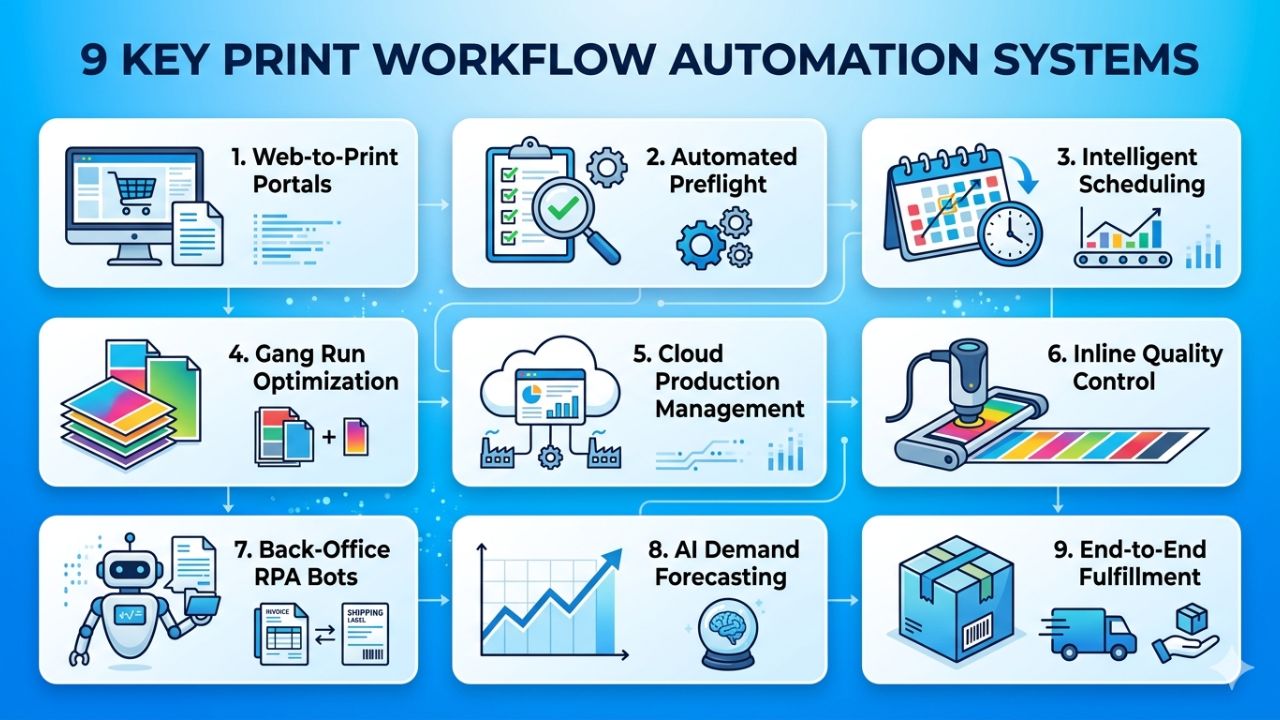
In 2025, print workflow automation is no longer optional. It represents the backbone of modern print operations, connecting disparate systems, reducing bottlenecks, and allowing businesses to scale operations without proportionally increasing labor costs. This article examines nine key automation solutions that are fundamentally changing how the print industry operates.
What is Print Workflow Automation?
Print workflow automation refers to the use of software systems, APIs, and integrated technologies to automate repetitive tasks across the print production cycle. This includes job intake, file processing, preflight checks, imposition, color management, production scheduling, and order fulfillment. By implementing print workflow automation, businesses reduce manual intervention, minimize human error, and accelerate time-to-delivery.
Modern print workflow automation solutions leverage technologies such as artificial intelligence, machine learning, cloud computing, and RESTful APIs to create intelligent, self-adjusting workflows. These systems can make decisions based on job parameters, route files to appropriate production equipment, and trigger downstream processes without operator input.
1. Web-to-Print Automation Platforms
Web-to-print systems represent one of the most transformative applications of print workflow automation. These platforms allow end customers to design, customize, and order print products through browser-based interfaces. The automation occurs across multiple touchpoints in the customer journey.
How It Works
When a customer places an order through a web-to-print portal, print workflow automation handles order validation, payment processing, file generation, and job ticket creation. The system automatically routes print-ready files to production queues based on specifications like substrate type, finishing requirements, and delivery deadlines.
Technical Architecture
Modern web-to-print platforms built by providers like DesignNBuy utilize API-driven modular architecture, allowing independent scaling of design tools, order management, and production modules. These systems integrate with MIS (Management Information Systems) and ERP (Enterprise Resource Planning) software through REST APIs, ensuring real-time data synchronization.
Industry Impact
Print workflow automation through web-to-print platforms has reduced order processing time from hours to minutes. Businesses report up to 70% reduction in order entry errors and significant improvements in customer satisfaction due to real-time order tracking and instant proofing capabilities.
2. Automated Preflight and File Preparation
Preflight checks traditionally required skilled operators to manually review files for issues like missing fonts, incorrect color spaces, low-resolution images, and improper bleed settings. Print workflow automation has transformed this process into an instantaneous, system-driven operation.
Automated Validation
Modern preflight systems use rule-based engines to automatically detect and flag issues. Advanced print workflow automation solutions can even attempt automatic corrections, such as converting RGB images to CMYK, embedding fonts, or adjusting document dimensions to match production requirements.
Integration with Job Management
These automated preflight systems integrate directly with job management workflows. When issues are detected, the system can automatically reject the job, notify the customer or account manager, and provide detailed error reports. This level of print workflow automation prevents production delays and material waste.
Machine Learning Applications
Some cutting-edge solutions now incorporate machine learning algorithms that learn from historical corrections. Over time, these systems become better at predicting and automatically resolving common file issues, further reducing the need for manual intervention.
3. Intelligent Job Scheduling and Resource Allocation
Production scheduling in print environments involves complex variables including machine availability, operator skills, substrate inventory, finishing equipment capacity, and delivery deadlines. Print workflow automation brings algorithmic optimization to this traditionally manual process.
Dynamic Scheduling Algorithms
Automated scheduling systems use algorithms that consider multiple constraints simultaneously. These print workflow automation solutions can reorder jobs in real-time based on priority changes, equipment failures, or material shortages. The system automatically recalculates optimal production sequences to minimize makeready time and maximize throughput.
Resource Management
Print workflow automation extends to resource allocation, tracking consumables like ink, toner, substrates, and finishing materials. When inventory reaches predetermined thresholds, the system can automatically generate purchase orders or alert procurement teams.
Predictive Analytics
Advanced implementations incorporate predictive analytics to forecast production capacity, identify potential bottlenecks before they occur, and recommend staffing adjustments. This proactive approach to print workflow automation helps businesses maintain consistent delivery performance even during peak demand periods.
4. Automated Imposition and Gang Run Optimization
Imposition involves arranging multiple page images on a single press sheet to maximize material usage and production speed. Gang runs combine multiple jobs on the same sheet. Both processes benefit significantly from print workflow automation.
Algorithmic Imposition
Automated imposition software calculates optimal layouts based on job specifications, press capabilities, and finishing requirements. Print workflow automation systems can test thousands of potential configurations in seconds, selecting arrangements that minimize waste while meeting all production constraints.
Gang Run Management
For digital and offset printers, gang run optimization represents substantial cost savings. Print workflow automation identifies jobs with compatible specifications (substrate, ink coverage, delivery timing) and automatically groups them for combined production. This reduces setup time and material consumption.
Integration with JDF/JMF
Modern imposition automation integrates with Job Definition Format (JDF) and Job Messaging Format (JMF) standards, allowing seamless communication between prepress systems and production equipment. This standardized approach to print workflow automation ensures consistency across multi-vendor environments.
5. Cloud-Based Print Production Management
Cloud computing has introduced new possibilities for print workflow automation by enabling real-time collaboration, remote access, and scalable computing resources. Cloud-based production management systems coordinate activities across multiple facilities, vendors, and customer touchpoints.
Centralized Control
Cloud platforms provide centralized dashboards where operators monitor jobs across geographically distributed production facilities. Print workflow automation ensures that jobs route to the most appropriate facility based on capacity, capabilities, and proximity to the delivery destination.
API-Driven Integration
Cloud-based systems expose comprehensive APIs that allow third-party applications to trigger workflows, query job status, and retrieve production data. This API-first approach to print workflow automation facilitates integration with customer systems, shipping carriers, and financial software.
Scalability and Redundancy
Cloud infrastructure automatically scales computing resources based on demand. During high-volume periods, print workflow automation systems can provision additional processing capacity for tasks like file rendering, color conversion, and imposition calculation. Built-in redundancy ensures continuous operation even during infrastructure failures.
6. Automated Color Management and Quality Control
Color consistency remains one of the most challenging aspects of print production. Print workflow automation addresses this through automated color management systems that ensure color accuracy across different substrates, presses, and viewing conditions.
ICC Profile Automation
Automated color management systems apply appropriate ICC (International Color Consortium) profiles based on job specifications. Print workflow automation matches source color spaces with device color spaces, performing necessary conversions without operator intervention.
Inline Quality Control
Modern presses equipped with inline spectrophotometers generate real-time color measurements during production runs. Print workflow automation systems compare these measurements against target values and automatically adjust ink densities to maintain color consistency. When deviations exceed acceptable tolerances, the system can pause production and alert operators.
Digital Twin Technology
Advanced implementations create digital twins of printed materials, simulating how colors will appear under different lighting conditions and on various substrates. This level of print workflow automation allows customers to approve colors digitally before physical production begins.
7. Robotic Process Automation (RPA) for Back-Office Operations
While much print workflow automation focuses on production processes, back-office operations like invoicing, shipping coordination, and customer communication also benefit from automation. Robotic Process Automation (RPA) technologies handle these repetitive administrative tasks.
Invoice Generation and Processing
RPA bots automatically generate invoices based on completed jobs, applying appropriate pricing rules, discounts, and tax calculations. These print workflow automation solutions can also process incoming invoices from suppliers, matching them against purchase orders and flagging discrepancies for human review.
Shipping and Logistics Automation
Integration with shipping carrier APIs allows print workflow automation systems to automatically select optimal carriers based on delivery requirements and cost parameters. The system generates shipping labels, schedules pickups, and sends tracking information to customers without manual intervention.
Customer Communication
Automated notification systems keep customers informed throughout the production cycle. Print workflow automation triggers emails or SMS messages at key milestones such as order confirmation, production start, quality approval, and shipment. These communications can include tracking links, proof approvals, and estimated delivery times.
8. Artificial Intelligence for Demand Forecasting and Inventory Management
Artificial intelligence and machine learning bring predictive capabilities to print workflow automation. These technologies analyze historical data to forecast demand, optimize inventory levels, and identify operational improvements.
Demand Prediction
AI-powered print workflow automation systems analyze order patterns, seasonal trends, and customer behavior to predict future demand. This allows businesses to proactively adjust staffing, order materials, and schedule maintenance activities. Prediction accuracy improves over time as the system learns from actual outcomes.
Inventory Optimization
Machine learning algorithms determine optimal inventory levels for substrates, inks, and finishing materials. Print workflow automation systems balance the costs of holding inventory against the risks of stockouts and production delays. The system can automatically reorder materials when quantities fall below calculated thresholds.
Anomaly Detection
AI-driven monitoring identifies unusual patterns in production data that may indicate equipment problems, quality issues, or process inefficiencies. This proactive approach to print workflow automation helps businesses address problems before they impact customer deliveries or product quality.
9. End-to-End Order Fulfillment Automation
Complete order fulfillment automation represents the ultimate goal of print workflow automation, connecting every step from initial customer contact through final delivery. These comprehensive systems orchestrate activities across sales, production, finishing, shipping, and billing.
Unified Data Model
End-to-end print workflow automation requires a unified data model where all systems share common definitions for products, customers, specifications, and status codes. This data consistency enables seamless handoffs between workflow stages without manual data re-entry.
Event-Driven Architecture
Modern fulfillment automation uses event-driven architectures where completion of one task automatically triggers the next. When a press operator marks a job as complete, print workflow automation initiates finishing operations, updates inventory, triggers quality control checks, and alerts the shipping department.
Customer Self-Service
Advanced fulfillment platforms provide customers with self-service portals for order tracking, reordering, and issue resolution. Print workflow automation populates these portals with real-time data from production systems, giving customers visibility into job status without requiring staff intervention.
Performance Analytics
Comprehensive analytics dashboards provide visibility into key performance indicators across the entire fulfillment process. Print workflow automation systems track metrics like on-time delivery rates, production cycle times, error rates, and profitability by job type. This data drives continuous improvement initiatives.
The Future of Print Workflow Automation
As we progress through 2025, print workflow automation continues to advance. Emerging technologies like computer vision for automated quality inspection, blockchain for supply chain transparency, and 5G connectivity for real-time remote equipment monitoring will further transform print operations.
The businesses that successfully implement print workflow automation gain significant competitive advantages through reduced costs, faster turnaround times, improved quality consistency, and better customer experiences. As customer expectations continue to rise and profit margins face pressure, print workflow automation transitions from competitive advantage to operational necessity.
Also Read: Top Smartphone and iPhone Giveaways You Can Join in 2026