
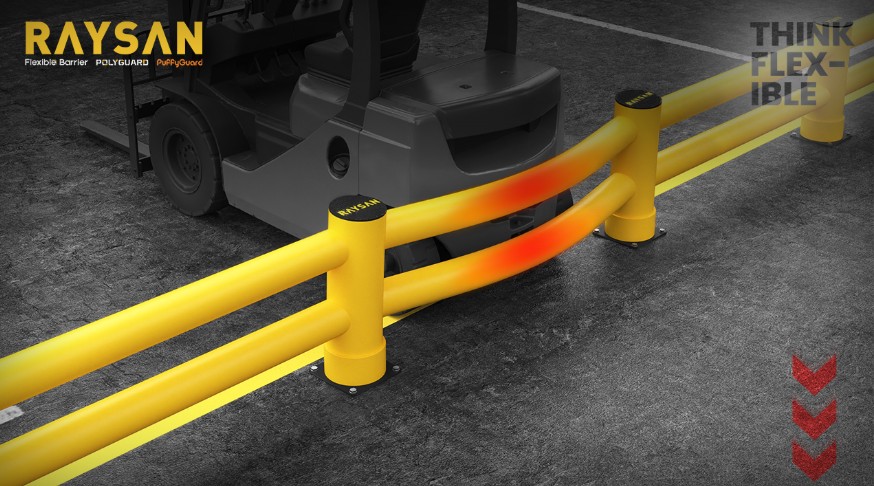
Modern warehouses are designed for speed: tighter aisle geometry, higher picking frequency, and constant equipment movement. That efficiency comes with a predictable downside—impact exposure. A single forklift contact can compromise racking stability, damage inventory, disrupt flow, and trigger unplanned maintenance that cascades across shifts.
In this environment, protection is not a “nice to have.” It is a structural requirement for uptime, safety, and asset longevity. The most effective facilities treat collision risk as a design variable and invest in systems that manage impact energy in controlled, repeatable ways.
To support this standard, Raysan positions warehouse protection as an integrated strategy—combining point-specific racking reinforcement with flexible perimeter control that keeps traffic moving.
Why Warehouse Impacts Happen at the Base, Not the Top
Operational reality is consistent: equipment rarely hits racking where it is easiest to see. Most contact occurs low—at the upright base—when turning clearance is tight, pallets overhang, visibility is reduced, or operators are working under time pressure.
This matters because the base of the rack is a critical load path. When upright geometry shifts—even slightly—beam alignment, load distribution, and long-term structural reliability can be affected. The goal of modern protection is therefore straightforward: stabilise the most vulnerable points and absorb impact before damage propagates.
Rack Leg Protector: Targeted Defence for Upright Stability
A rack leg protector provides concentrated protection exactly where collisions most often occur. Rather than relying on signage or painted floor lines, it creates a physical intervention at the rack’s most exposed structural element.
The value is not only in preventing immediate deformation. By limiting progressive damage at the base, a rack leg protector helps maintain rack alignment over time, reduces repair cycles, and lowers the probability of larger incidents linked to compromised stability.
In high-density storage environments, this targeted protection typically contributes to:
- Reduced upright distortion in narrow aisles and turning zones
- Improved long-term racking integrity through better load-path stability
- Lower frequency of emergency repairs, replacement parts, and disruption
- More predictable safety performance in areas with repeated low-speed contact
Polymer Barrier Systems: Flexible Control for Repeated Impacts
Point protection is only one layer of warehouse resilience. Busy aisles, rack ends, and active pick faces also require perimeter control—a system that manages repeated side impacts without creating new damage elsewhere.
A polymer barrier approach is engineered around energy management. Unlike rigid steel systems that can transmit force into concrete or adjacent structures, polymer-based designs can flex under impact, absorb kinetic energy, and return toward their original geometry—supporting repeatable performance in high-traffic zones.
In practice, flexible barriers are particularly useful where collisions are frequent but typically low to mid intensity—the everyday bumps that accumulate into major cost if left unmanaged.
Operational benefits commonly associated with polymer barrier systems include:
- Reduced force transmission into flooring and nearby infrastructure
- High-visibility guidance that improves operator awareness in busy aisles
- Modular expansion options when layouts or traffic patterns change
- Lower ongoing maintenance burden versus systems that bend, corrode, or require repainting
Two Layers, One Protection Architecture
The strongest warehouse protection strategies recognise that different collision types require different tools. A rack leg protector manages direct contact at the upright base. Polymer barriers manage repeated lateral impacts across aisles, rack ends, and sensitive working zones. Together, they form a coherent architecture that reduces both incident severity and operational noise.
This dual-layer approach also improves traffic discipline. When barriers are clearly visible and physically enforce movement boundaries, operators make fewer last-second corrections, and pedestrian routes become easier to control.
Lifecycle Value: Repair Less, Replace Less, Interrupt Less
Warehouse protection should be evaluated on lifecycle performance, not only initial install. Systems that deform after impact can create a recurring expense pattern: repairs, replacements, downtime, and the hidden cost of disrupted workflows.
By prioritising structures that are designed to absorb and recover, facilities can reduce replacement cycles and keep protection performance stable as throughput grows. When combined with targeted rack reinforcement, the outcome is measurable: fewer damage events, less downtime, and more reliable inventory stability.
Where to Start: A Practical Deployment Sequence
A sensible rollout focuses first on the zones where impact probability and consequence are highest. Most facilities see fast results by protecting:
- Rack uprights at aisle ends, high-speed turns, and staging interfaces
- High-traffic pick corridors where pallets and equipment move continuously
- Infrastructure edges near charging stations, doors, columns, and machinery
- Pedestrian-adjacent areas where separation must remain enforceable
Once the highest-risk points are secured, sites can expand barrier coverage as layouts evolve—maintaining consistent protection without redesigning the entire facility.
Conclusion: Protection as a Productivity Strategy
In high-throughput logistics, impact events are not anomalies; they are operational realities. The difference between costly disruption and controlled continuity is whether the site is designed to manage collision energy at the right locations.