
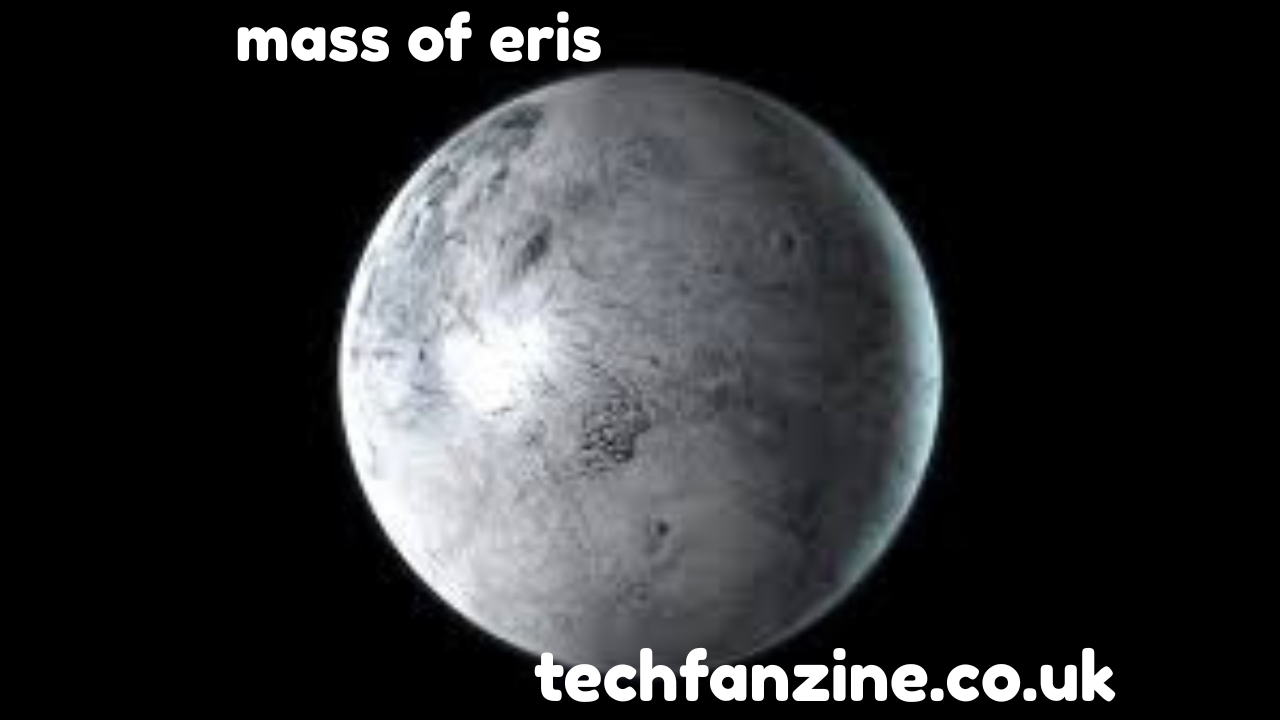
Introduction to the Mass of Eris
The mass of Eris is one of the most discussed and scientifically important measurements in modern planetary astronomy. Eris is a distant dwarf planet located in the outer reaches of our solar system, far beyond Neptune in the Kuiper Belt region. When astronomers first began studying Eris, its size, brightness, and especially the mass of Eris challenged long-standing ideas about what qualifies as a planet. The mass of Eris is not just a number; it plays a central role in understanding the structure of the solar system, the reclassification of Pluto, and the discovery of new categories of celestial objects.
In simple terms, the mass of Eris tells scientists how much matter the dwarf planet contains. This measurement helps determine its gravitational influence, density, internal composition, and its relationship with other Kuiper Belt objects. Over time, improved observational techniques have refined the mass of Eris, making it one of the best-measured dwarf planets in the solar system.
Discovery of Eris and Why Mass Became Important

The discovery of Eris occurred in January 2005, although images of the object dated back to 2003. Astronomers Michael Brown, Chad Trujillo, and David Rabinowitz identified Eris while surveying the outer solar system. At the time of the discovery of Eris, it appeared to be larger and potentially more massive than Pluto, which immediately raised serious scientific questions.
The discovery of Eris forced astronomers to look closely at the mass of Eris because mass is a critical factor in planetary classification. If Eris had a greater mass than Pluto, then logically it could not be ignored or treated differently. This directly contributed to the International Astronomical Union’s decision in 2006 to redefine the term “planet” and introduce the category of “dwarf planet.”
Thus, the mass of Eris became a turning point in astronomy. Without accurately measuring the mass of Eris, the debate surrounding Pluto’s status and the discovery of new dwarf planets would have lacked scientific clarity.
What Is the Mass of Eris?

The mass of Eris is approximately 1.66 × 10²² kilograms, which makes it slightly more massive than Pluto. Although Eris is similar in size to Pluto, its higher density results in a greater mass. This makes the mass of Eris especially significant because it demonstrates that size alone does not determine mass.
To put the mass of Eris into perspective, it is about 27 percent of the Moon’s mass and roughly 0.0028 times the mass of Earth. While this may sound small compared to planets like Earth or Jupiter, within the Kuiper Belt, the mass of Eris makes it one of the most massive known objects.
Understanding the mass of Eris allows astronomers to calculate its gravitational pull, orbital stability, and long-term behavior within the solar system. It also helps compare Eris with other dwarf planets such as Pluto, Haumea, and Makemake.
How Scientists Measured the Mass of Eris
The mass of Eris was determined primarily through observations of its moon, Dysnomia. Dysnomia orbits Eris, and by carefully tracking this orbit, scientists could apply gravitational equations to calculate the mass of Eris accurately.
This method is widely used in astronomy because measuring the mass of isolated objects in space is extremely difficult. The presence of a satellite makes it possible to determine mass based on orbital speed and distance. In the case of Eris, long-term observations using powerful telescopes provided reliable data.
As observational technology improved, astronomers refined the mass of Eris further, reducing uncertainties and confirming that Eris is indeed slightly more massive than Pluto. These measurements also confirmed that the mass of Eris is stable and well understood compared to many other distant objects.
Density and Composition Linked to the Mass of Eris
The mass of Eris, combined with its size, allows scientists to calculate its density. Eris has a relatively high density for a dwarf planet, suggesting a rocky interior covered by a thick layer of ice. This density indicates that Eris contains a larger proportion of rock compared to some other Kuiper Belt objects.
The mass of Eris also implies strong gravity relative to its size. This gravity helps Eris retain a thin atmosphere when it is closer to the Sun during its long orbit. The composition inferred from the mass of Eris includes frozen methane, nitrogen, and possibly other volatile compounds on its surface.
These findings connect the mass of Eris directly to planetary formation theories. A higher mass suggests Eris formed in a region of the solar system rich in solid materials, allowing it to accumulate more matter during its formation.
Orbit and Distance Effects on the Mass of Eris
While the mass of Eris itself does not change, its orbit plays a role in how scientists observe and interpret it. Eris has a highly elliptical orbit that takes it far beyond the Kuiper Belt, sometimes more than three times farther from the Sun than Pluto.
Because of this distance, early estimates of the mass of Eris were challenging. Only with improved instruments could astronomers precisely track Dysnomia and confirm the mass of Eris. Its long orbital period of about 558 Earth years makes continuous observation difficult, but modern astronomy has overcome many of these challenges.
The stable mass of Eris also means it has remained gravitationally dominant in its local region, another factor considered when defining dwarf planets.
Comparison Between the Mass of Eris and Pluto
One of the most common comparisons in astronomy is between the mass of Eris and the mass of Pluto. Although Pluto is slightly larger in volume, the mass of Eris is greater due to its higher density.
This comparison was central to the planetary debate following the discovery of Eris. If Pluto was a planet, then logically Eris should also be considered a planet based on its mass. Instead of expanding the list of planets indefinitely, astronomers chose to redefine planetary classification.
Today, both objects are classified as dwarf planets, but the mass of Eris remains a benchmark for comparing other distant objects discovered in the Kuiper Belt.
Scientific Importance of the Mass of Eris
The mass of Eris is important beyond classification debates. It helps scientists understand the distribution of mass in the outer solar system. By comparing the mass of Eris with other Kuiper Belt objects, astronomers can refine models of solar system evolution.
The mass of Eris also influences simulations of gravitational interactions in the Kuiper Belt. Even small differences in mass can affect orbital stability over billions of years. Therefore, accurate mass measurements are essential for long-term modeling.
Additionally, the mass of Eris contributes to our understanding of how dwarf planets differ from both small icy bodies and full-sized planets.
Role of the Discovery of Eris in Modern Astronomy
The discovery of Eris was one of the most influential astronomical events of the 21st century. It highlighted the limitations of existing definitions and demonstrated how new discoveries can reshape scientific thinking.
The mass of Eris played a direct role in this transformation. Without precise mass data, the discovery of Eris might not have had such a profound impact. Instead, it led to a clearer understanding of planetary diversity and encouraged further exploration of the Kuiper Belt.
Today, the discovery of Eris continues to inspire new surveys and missions aimed at uncovering additional distant objects and refining mass measurements across the solar system.
Conclusion: Why the Mass of Eris Matters
The mass of Eris is far more than a technical measurement. It represents a key piece of evidence in redefining what planets are and how the solar system is structured. From the discovery of Eris to ongoing research, the mass of Eris has influenced classification systems, formation theories, and observational methods.
By studying the mass of Eris, scientists gain insight into the nature of dwarf planets, the composition of the Kuiper Belt, and the processes that shaped the outer solar system. As technology advances, future studies may refine the mass of Eris even further, but its importance in astronomy is already firmly established.